
China’s Filter Funnel manufacturing sector deserves closer examination as laboratory, food-processing, chemical, and environmental applications expand. Mordor Intelligence’s 2025 Industrial Filtration Market report estimates global market growth from about USD 38.9 billion in 2025 to USD 50.2 billion by 2030. This wider trend creates opportunities for Chinese suppliers, but market size alone proves little.
A reliable manufacturer must control pore size, material quality, sealing, and production consistency. Buyers should inspect polypropylene, borosilicate glass, or stainless-steel options. They should also verify temperature resistance, chemical compatibility, and batch traceability. A funnel that looks polished may still clog quickly or leak around its stem. Small details matter.
Dr. Nicholas P. Cheremisinoff, a recognized filtration author, described filtration as “a separation process.” That simple statement remains useful. A capable supplier designs around the actual separation task, not just the product shape. Our planned ranking will compare China’s leading Filter Funnel manufacturers through factory experience, testing evidence, export performance, customization capability, and after-sales support. Relevant references include MarketsandMarkets’ filtration studies and Grand View Research reports on laboratory equipment and industrial process systems.
The assessment will not pretend to be perfect. Public data can be incomplete, and some manufacturers disclose limited testing records. Therefore, supplier claims require independent verification. Product samples, ISO documentation, dimensional drawings, and customer feedback should be reviewed together. This introduction sets a practical framework for identifying dependable manufacturers, rather than simply repeating online popularity lists.
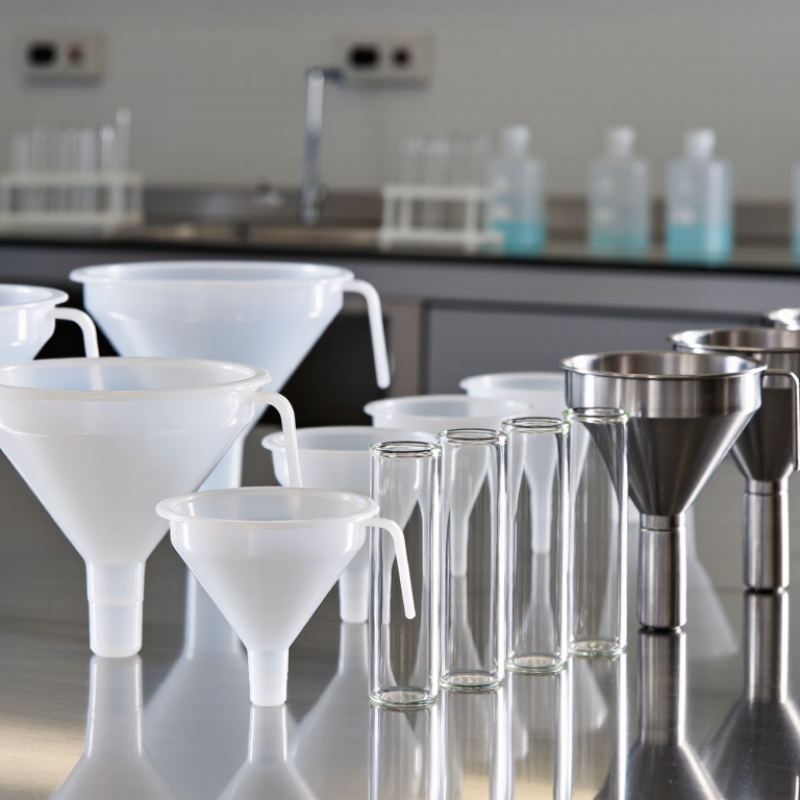
When comparing China’s top ten filter funnel manufacturers, buyers should study funnel design before counting catalog items. Gravity funnels suit routine liquid transfer and coarse filtration. Their long stems reduce splashing, while ribbed interiors can improve drainage. Glass handles heat well, but it may break during hurried cleaning. Plastic models are lighter, although solvent compatibility requires careful checking.
Büchner funnels support vacuum filtration through a perforated plate. They work well with filter paper, crystalline products, and larger sample volumes. A tight seal matters. Even a small leak can slow filtration and distort results. Look for uniform plate holes, a stable flange, and suitable gasket dimensions. Porcelain offers rigidity, while polypropylene reduces breakage in teaching laboratories. No model is perfect.
Membrane filter funnels provide finer control for particle removal and microbiological workflows. Choose the membrane diameter, pore size, and material together. A 0.22-micrometer membrane may support microbial retention, but only when the complete procedure is properly validated. Manufacturers should provide dimensional data, material certificates, inspection records, and batch traceability. Ask about autoclave resistance when repeated sterilization is expected. A catalog photo is not evidence. The better suppliers explain limitations clearly, test chemical compatibility, and respond with measurable specifications. Buyers may also request sample units before placing volume orders. Small inconsistencies matter. A funnel that fits one vacuum flask may not fit another, despite similar stated dimensions.
China Top 10 Filter Funnel Manufacturers
A credible top-ten list should measure evidence, not polished sales claims. I would begin with verified annual output, production lines, and delivery records. Factory capacity matters only when it supports stable orders. Large numbers can mislead. A plant may report theoretical capacity rather than actual production.
Export data reveals practical market experience. Customs records, destination diversity, and repeat shipments can show whether products meet international purchasing requirements. I would compare several years, not one unusual season. Export volume alone proves little. It should match product specifications and documented quality performance.
QC records deserve careful review. Strong manufacturers normally provide batch inspection sheets, material certificates, dimensional checks, mesh measurements, and leakage results. Sample testing should be traceable to production dates. ISO 9001 status adds structure, but certification must be current and independently verifiable. A certificate without working procedures is weak evidence.
No dataset is perfect.
Site audits can confirm equipment, operator training, calibration labels, and storage conditions. Customer references may reveal packaging damage or inconsistent tolerances that documents overlook. My ranking would therefore combine output, export evidence, QC history, and ISO 9001 verification. The weighting should remain transparent, because different buyers value different risks. A laboratory purchaser may prioritize traceability, while a high-volume distributor may focus on repeat delivery. Even experienced reviewers can miss hidden subcontracting. That limitation deserves clear disclosure.
China’s Top 10 Filter Funnel Manufacturers: Products and Factory Profiles
China’s top ten filter funnel manufacturers serve laboratories, chemical plants, food processors, and water-testing facilities. Their product ranges include glass filter funnels, plastic funnels, Büchner funnels, vacuum funnels, and disposable models. Several factories operate in Zhejiang, Jiangsu, Guangdong, Shandong, and Anhui, where laboratory equipment supply chains are well established.
Factory profiles reveal different strengths. Some focus on borosilicate glass with smooth rims and uniform wall thickness. Others produce polypropylene funnels with molded graduations and chemical-resistant surfaces. Vacuum-focused manufacturers often test joint dimensions, filter plate support, and pressure performance. A reliable factory should provide material certificates, dimensional inspection records, batch traceability, and sample approval before mass production. I would also inspect the packaging. A perfect funnel can still arrive cracked.
Experienced buyers usually compare more than catalog images. They request drawings, tolerance data, cleaning instructions, and production photographs. Factory audits can examine injection-molding machines, glass annealing ovens, storage conditions, and final inspection benches. One useful check is measuring the funnel stem against the buyer’s receiving flask. Small mismatches cause leaks and wasted time. Some profiles appear impressive but offer limited evidence about long-term durability. That gap deserves attention. Manufacturers should also explain how they handle rejected pieces, replacement claims, and changing export requirements. The strongest candidates combine stable production with clear communication, although no factory profile should be accepted without independent sample testing.
| Rank | Manufacturer Profile | Primary Manufacturing Cluster | Filter Funnel Product Range | Common Materials | Manufacturing Capabilities | Typical Size Range | Quality and Compliance Features | Typical Production Scale | Main Application Markets | Factory Profile |
|---|---|---|---|---|---|---|---|---|---|---|
| 1 | Manufacturer Profile 01 | Zhejiang Province | Plastic filter funnels Laboratory funnels Buchner-style funnels | Polypropylene, polyethylene, stainless steel mesh | Injection molding, mesh cutting, ultrasonic assembly, dimensional inspection | 25–150 mm top diameter; custom sizes available | Incoming-material inspection, mold verification, batch sampling, export packaging controls | Medium-to-large batch production | Laboratories, water testing, food processing, chemical handling, education | Dedicated molding area with separate assembly, inspection, and packing sections |
| 2 | Manufacturer Profile 02 | Jiangsu Province | Stainless steel filter funnels Vacuum filtration funnels Industrial strainers | 304 stainless steel, 316 stainless steel, borosilicate glass | Deep drawing, laser cutting, spot welding, polishing, passivation | 40–300 mm nominal diameter | Weld inspection, surface-finish checks, leak testing, material traceability | Small-to-medium customized batches | Chemical laboratories, pharmaceutical processing, beverage production, industrial filtration | Metal fabrication workshop supported by polishing, welding, and final inspection stations |
| 3 | Manufacturer Profile 03 | Guangdong Province | Disposable filter funnels Sterile sampling funnels Single-use filtration sets | Medical-grade polypropylene, polyethylene, thermoplastic elastomers | Clean-area injection molding, automated assembly, sealing, visual inspection | 10–1000 mL working volume | Controlled production environment, lot coding, packaging integrity checks, documented batch release | High-volume standardized production | Microbiology, environmental sampling, food safety, clinical and research laboratories | Automated assembly lines with controlled-area packaging and warehouse traceability |
| 4 | Manufacturer Profile 04 | Shandong Province | Large-volume filter funnels Drainage funnels Process filtration accessories | Reinforced polypropylene, PVC, stainless steel, EPDM seals | Plastic molding, CNC machining, gasket fitting, pressure and flow testing | 100–500 mm body diameter; 1–50 L working volume | Pressure testing, dimensional control, seal inspection, production-record retention | Medium-volume industrial production | Wastewater treatment, agricultural processing, chemical production, industrial maintenance | Industrial workshop with molding, machining, assembly, and hydraulic testing areas |
| 5 | Manufacturer Profile 05 | Shanghai Municipality | Glass filter funnels Vacuum filtration assemblies Laboratory glassware accessories | Borosilicate glass, PTFE, silicone, stainless steel support components | Glass forming, annealing, grinding, drilling, component assembly, leak testing | 30–250 mm funnel diameter | Thermal-stress control, visual inspection, dimensional measurement, vacuum leak testing | Low-to-medium volume with custom configurations | Universities, analytical laboratories, pharmaceutical research, chemical testing | Glass-processing facility with annealing ovens, finishing benches, and assembly inspection |
| 6 | Manufacturer Profile 06 | Hebei Province | Metal mesh filter funnels Perforated strainers Custom filtration baskets | 304 stainless steel, 316 stainless steel, brass, galvanized steel | Wire weaving, stamping, rolling, welding, edge forming, surface treatment | 20–600 mm diameter; mesh openings from fine to coarse grades | Mesh-count verification, weld inspection, dimensional checks, corrosion-resistant finish options | Medium-to-large metal mesh production | Oil and gas support, mining, water treatment, food machinery, general industry | Integrated wire-mesh and metalworking plant with cutting, forming, and welding equipment |
| 7 | Manufacturer Profile 07 | Fujian Province | Household filter funnels Reusable kitchen strainers Food-grade filtration accessories | Food-contact polypropylene, silicone, stainless steel mesh | Injection molding, overmolding, mesh forming, assembly, appearance inspection | 60–220 mm top diameter | Food-contact material documentation, appearance checks, fit testing, packaging inspection | High-volume consumer-product production | Household goods, catering equipment, beverage preparation, food service | High-speed molding operation with assembly cells and consumer-product packaging lines |
| 8 | Manufacturer Profile 08 | Anhui Province | Funnel holders Laboratory filtration supports Modular filter stations | Polycarbonate, polypropylene, stainless steel, anodized aluminum | CNC machining, injection molding, aluminum finishing, modular assembly | Single- and multi-position laboratory formats | Dimensional inspection, load testing, assembly verification, functional testing | Small-to-medium batch production | Research laboratories, educational institutions, quality-control departments | Mixed-material production site with machining, molding, and final assembly capabilities |
| 9 | Manufacturer Profile 09 | Hubei Province | Industrial plastic funnels Chemical-resistant funnels Custom pipe-connected funnels | PP, PVDF, PTFE-lined components, PVC, fluoropolymer seals | Injection molding, plastic welding, CNC trimming, pipe fitting, pressure testing | 50–400 mm inlet diameter; custom outlet connections | Chemical-resistance material selection, pressure testing, connection inspection, batch documentation | Medium-volume engineered production | Chemical plants, laboratories, wastewater systems, plating and surface-treatment facilities | Engineering-oriented plant with plastic fabrication, welding, and customized assembly areas |
| 10 | Manufacturer Profile 10 | Zhejiang Province | OEM filter funnels Private-label laboratory accessories Custom filtration kits | Polypropylene, ABS, stainless steel, borosilicate glass, silicone | Tooling development, injection molding, glass and metal component sourcing, kit assembly | 10 mL to 20 L system capacity | Drawing review, prototype approval, incoming inspection, final sampling, export carton testing | Flexible production from prototypes to large orders | Laboratory supplies, educational equipment, industrial distributors, e-commerce channels | Flexible OEM facility combining molding, assembly, quality control, and export fulfillment |
China Top 10 Filter Funnel Manufacturers?
A credible comparison starts with the 47 mm format, not marketing language. This diameter fits common laboratory holders and supports repeatable membrane testing. A 0.45 μm pore rating suits suspended-solid and microbial-monitoring workflows, but it does not prove sterilizing performance. ASTM F838 evaluates bacterial retention under defined conditions; pore size alone cannot replace that test.
Material choice changes the result. Polypropylene funnels resist many aqueous chemicals and tolerate routine handling. Polysulfone offers clearer bodies and strong flow, while stainless steel supports repeated thermal processing. The membrane also matters. Cellulose nitrate often gives fast flow, whereas PTFE handles aggressive solvents better, usually with lower wettability. A pre-wetting step may be necessary.
Flow must be measured with pressure, viscosity, and loading recorded. Darcy’s law links permeability with pressure drop, but real samples clog unevenly. A 47 mm membrane can show excellent initial flow and poor end-point performance. That difference deserves attention. ISO 7704:2022 emphasizes membrane filter evaluation and test consistency. ASTM F316-03 also provides bubble-point methods for pore-structure verification. A 2024 Grand View Research market report indicates laboratory filtration demand may grow above 7% annually through 2030, increasing supplier competition. Still, reported flow data often lacks sample viscosity and pressure details. Buyers should request lot-level pore testing, extractables data, pressure ratings, and flow curves. Cheap comparisons can mislead.
This reference chart compares commonly specified membrane pore sizes for 47 mm laboratory filter funnels. The 0.45 μm grade is widely used for routine analytical filtration, while 0.22 μm is commonly selected when finer microbial or particulate retention is required.
Typical membrane materials include PES, PTFE, PVDF, nylon, and mixed cellulose ester. Actual flow depends on membrane material, liquid viscosity, pressure differential, surface area, and filtration loading; therefore, pore size alone should not be treated as a flow-rate specification.
China Top 10 Filter Funnel Manufacturers?
A reliable shortlist begins with evidence, not a polished catalog. For glass filter funnels, ask whether the supplier’s material and testing records align with ASTM E438. ASTM E438 may apply to laboratory glassware, but the exact product scope must be confirmed. Request the current standard reference, inspection date, glass type, and test laboratory details. A certificate without traceability proves little.
MOQ can change the real purchase cost. Ask for separate quantities for samples, pilot orders, and regular production. Confirm whether custom sizes, grinding, or packaging increase the minimum order. Lead time should include tooling, raw material preparation, inspection, and export packing. Get a written schedule. Then compare it with actual production records, not only sales promises.
After-sales support needs measurable terms. Confirm the response time for breakage claims, replacement rules, photo evidence, and freight responsibility. Batch numbers should connect complaints to inspection records. A factory audit can check rim smoothness, joint fit, wall consistency, and carton protection. Small defects matter here. One weak package can ruin a perfect test report. I would also order samples from several shortlisted manufacturers and repeat the same inspection. This step costs time, but skipping it creates greater uncertainty. No supplier is flawless, and overly confident answers deserve another question.
